Agentic AI in 2026: From Simple Prompts to Intelligent Action
The Next Phase of Generative AI
Generative AI is moving beyond answering questions and creating content. The latest shift is toward agentic AI, where AI systems can understand goals, create plans, use business tools, and perform actions with human guidance.
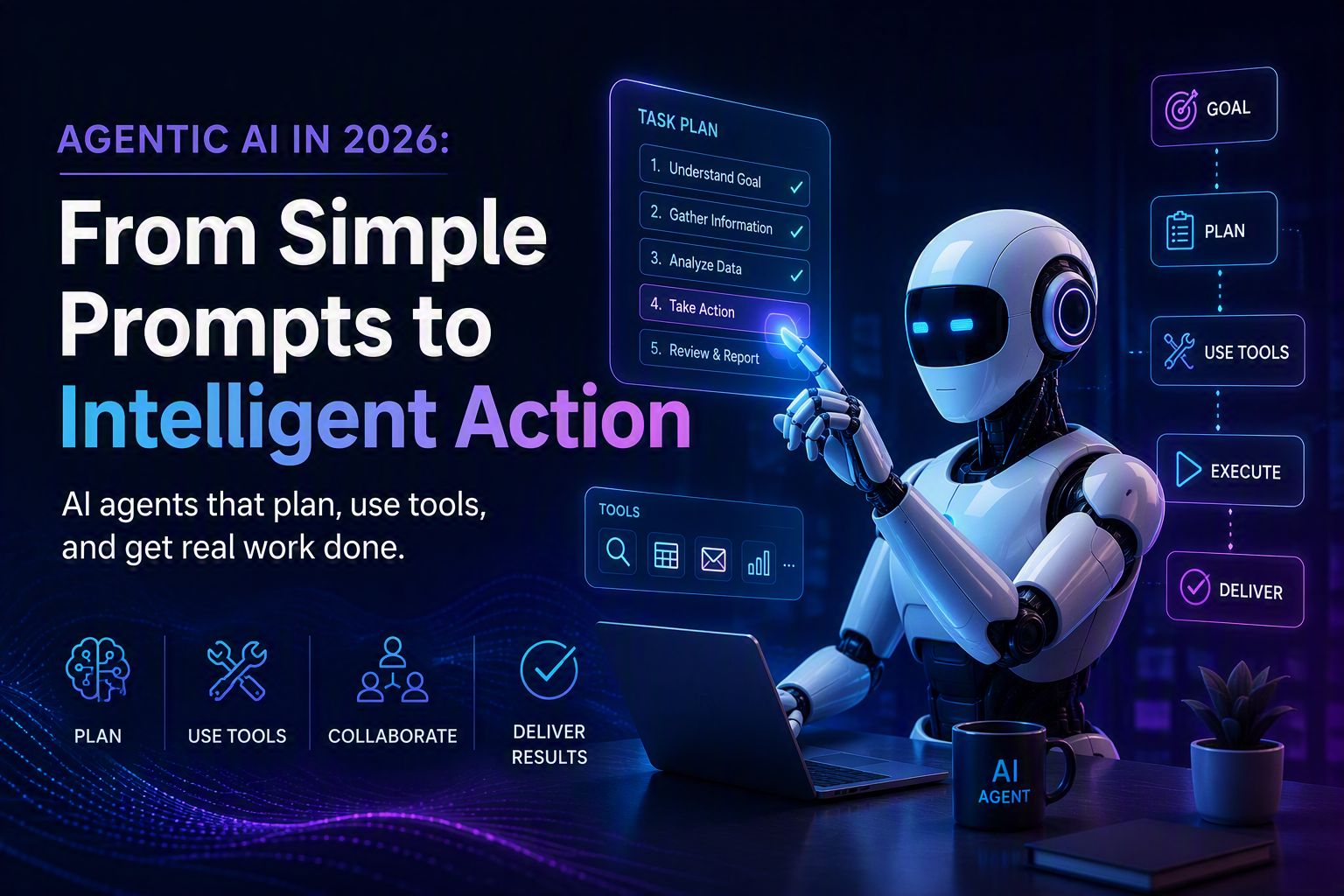
Instead of responding to a single prompt, an AI agent can complete a sequence of connected tasks. For example, an agent could analyze customer feedback, identify recurring problems, prepare a report, create follow-up tasks, and notify the responsible team.
Why Agentic AI Is Trending
Businesses are increasingly embedding AI directly into everyday workflows. The focus is shifting from standalone chat interfaces to goal-driven systems that participate in customer service, software development, research, security, finance, and business operations.
This transformation makes generative AI more practical because organizations can connect models with company data, applications, APIs, and automation tools.
Key Capabilities of AI Agents
1. Planning
AI agents can break a larger objective into smaller, manageable steps and determine the order in which those steps should be completed.
2. Tool Use
Agents can interact with approved tools such as databases, search systems, email platforms, business applications, and internal APIs.
3. Context and Memory
Modern agentic systems can retain relevant context, reference trusted organizational information, and use previous interactions to improve task completion.
4. Multi-Agent Collaboration
Organizations can create groups of specialized agents. One agent might conduct research, another might analyze the information, and another might review the final output.
5. Human Oversight
Human approval remains essential for sensitive, high-impact, or irreversible actions. Effective agentic systems include permissions, review stages, audit logs, and clear escalation processes.
Business Applications
Agentic AI can support a wide range of business activities, including:
- Resolving and routing customer support requests
- Generating, testing, and documenting software
- Preparing reports from multiple data sources
- Reviewing documents and extracting key information
- Monitoring operational processes
- Assisting sales and marketing teams
- Automating repetitive administrative workflows
The Importance of Responsible Deployment
Greater autonomy also introduces greater responsibility. Organizations must protect sensitive data, control system access, monitor AI outputs, and define which decisions require human approval.
Successful adoption depends on more than selecting a powerful model. Businesses also need reliable data, measurable objectives, security controls, evaluation processes, and clearly defined accountability.
What Comes Next
The future of generative AI will not be defined only by models that produce better answers. It will be shaped by systems that can safely turn those answers into useful actions.
Organizations that combine agentic capabilities with strong governance and meaningful human oversight will be better positioned to transform AI experiments into reliable business solutions.